
01 · Screen the duty
Match torque and speed over time
Compare rated and peak values with the actual motion profile, including peak duration, repetition, acceleration, and thermal conditions. Do not size from peak torque alone.
Planetary integrated joint actuator
Both Model 1 and Model 2 are populated, and the source gives both a 36:1 ratio. The visible table still lists separate electrical and output values, so compare the complete columns rather than assuming the labels mean interchangeable options. Model 1 is listed at 82 Nm peak torque and 64 rpm peak speed.
What changes between Model 1 and Model 2 when both columns use a 36:1 ratio?
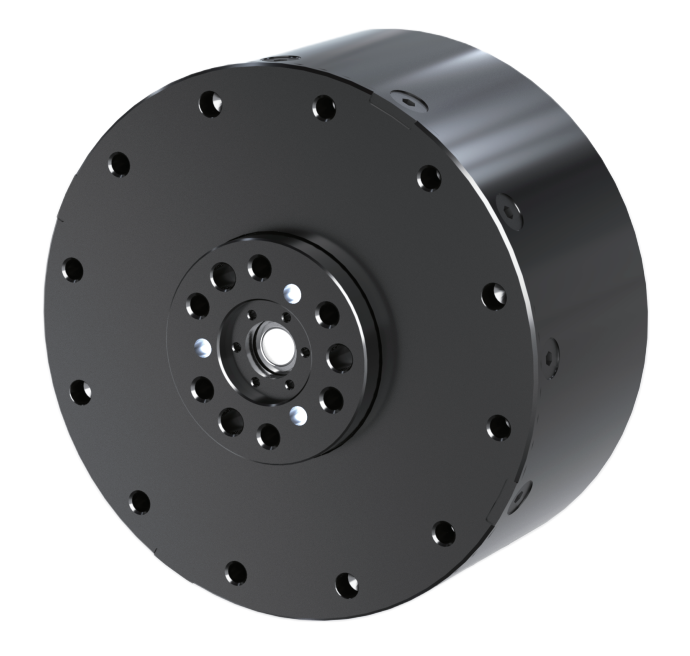
Model 1 summary
Summary values are transcribed from the catalogue strip and checked against the Model 1 table. They are not a substitute for an application duty-cycle review.
MGA-PJ-72-10-36 is identified in the supplied product literature as a planetary integrated joint actuator. The specification tables below retain the source's Model 1 and Model 2 labels and every listed field.
A catalogue value narrows the comparison. It does not establish fit for a mechanism without the load profile, mounting stack, controller, and operating environment.
The catalogue labels its columns Model 1 and Model 2 but does not define the difference between them. Both labels are retained as published. A source dash or unpopulated cell is presented as “Not specified in source.”
| Parameter | Unit | Model 1 | Model 2 |
|---|---|---|---|
| Operating voltage | V | 12-72 | 12-72 |
| Rated voltage | V | 48 | 48 |
| Rated torque | Nm | 27 | 18 |
| Rated speed | RPM | 30 | 70 |
| Rated current | A(rms) | 7 | 12 |
| Peak torque (>3 s) | Nm | 82 | 60 |
| Peak speed | RPM | 64 | 133 |
| Peak current | A(rms) | 17 | 30 |
| Torque constant | Nm/A | 5 | 2.03 |
| Back-EMF constant | Vrms/Krpm | Not specified in source | Not specified in source |
| Speed constant | rpm/V | 50 | 100 |
| Motor constant | Nm/√W | Not specified in source | Not specified in source |
| Electromechanical time constant | ms | Not specified in source | Not specified in source |
| Electrical time constant | ms | Not specified in source | Not specified in source |
| Pole pairs | — | 21 | 21 |
| Winding connection | — | Star | Delta |
| Phase resistance | Ω | 0.87 | 0.17 |
| Phase inductance | mH | 0.63 | 0.085 |
| Parameter | Unit | Model 1 | Model 2 |
|---|---|---|---|
| Reduction ratio | — | 36 | 36 |
| Reducer backlash | Arcmin | 10 | 10 |
| Output bearing | — | Crossed-roller bearing | Crossed-roller bearing |
| Backdrive torque | Nm | 1.5 | 1.5 |
| Rotational inertia | g.cm² | Not specified in source | Not specified in source |
| Weight | g | 630 | 630 |
| Axial load | kN | 4.8 | 4.8 |
| Radial load | kN | 2.1 | 2.1 |
| Parameter | Unit | Model 1 | Model 2 |
|---|---|---|---|
| Control bandwidth | Hz | 2000 | 2000 |
| Communication | — | CAN | CAN |
| Encoder type | — | Mechanical dual encoder | Mechanical dual encoder |
| Encoder resolution | bit | 14 | 14 |
| CAN interface | — | XT30(2+2)PB-M | XT30(2+2)PB-M |
| USB interface | — | SH1.0-4P | SH1.0-4P |
| Power interface | — | XT30(2+2)PB-M | XT30(2+2)PB-M |
| Control modes | — | Servo mode; Speed mode; Torque mode; Force-position hybrid mode | Servo mode; Speed mode; Torque mode; Force-position hybrid mode |
| Protection functions | — | Overvoltage protection; Overcurrent protection; Overtemperature protection | Overvoltage protection; Overcurrent protection; Overtemperature protection |
| Parameter | Unit | Model 1 | Model 2 |
|---|---|---|---|
| Duty type | — | S2 | S2 |
| Ingress protection | — | IP40 | IP40 |
| Cooling method | — | IC410 | IC410 |
| Ambient operating temperature | — | -20℃~50℃ | -20℃~50℃ |
| Insulation class | — | F | F |
| Dielectric strength | — | 500V 1kHz 1A 1ms | 500V 1kHz 1A 1ms |
| Insulation resistance | — | 100MΩ 20℃ | 100MΩ 20℃ |
| Noise | — | 60dB/1.0m | 60dB/1.0m |
| Temperature sensor | — | NTC MF52B 103F3950 | NTC MF52B 103F3950 |
All data are provided for U= 48 V and T= 25°C, unless otherwise specified. Specifications for different voltage levels or other operating limits, and corresponding simulation models, are available upon request.
Send it with the duty cycle and controller requirements for a model-specific engineering review.
01 · Screen the duty
Compare rated and peak values with the actual motion profile, including peak duration, repetition, acceleration, and thermal conditions. Do not size from peak torque alone.
02 · Check interfaces
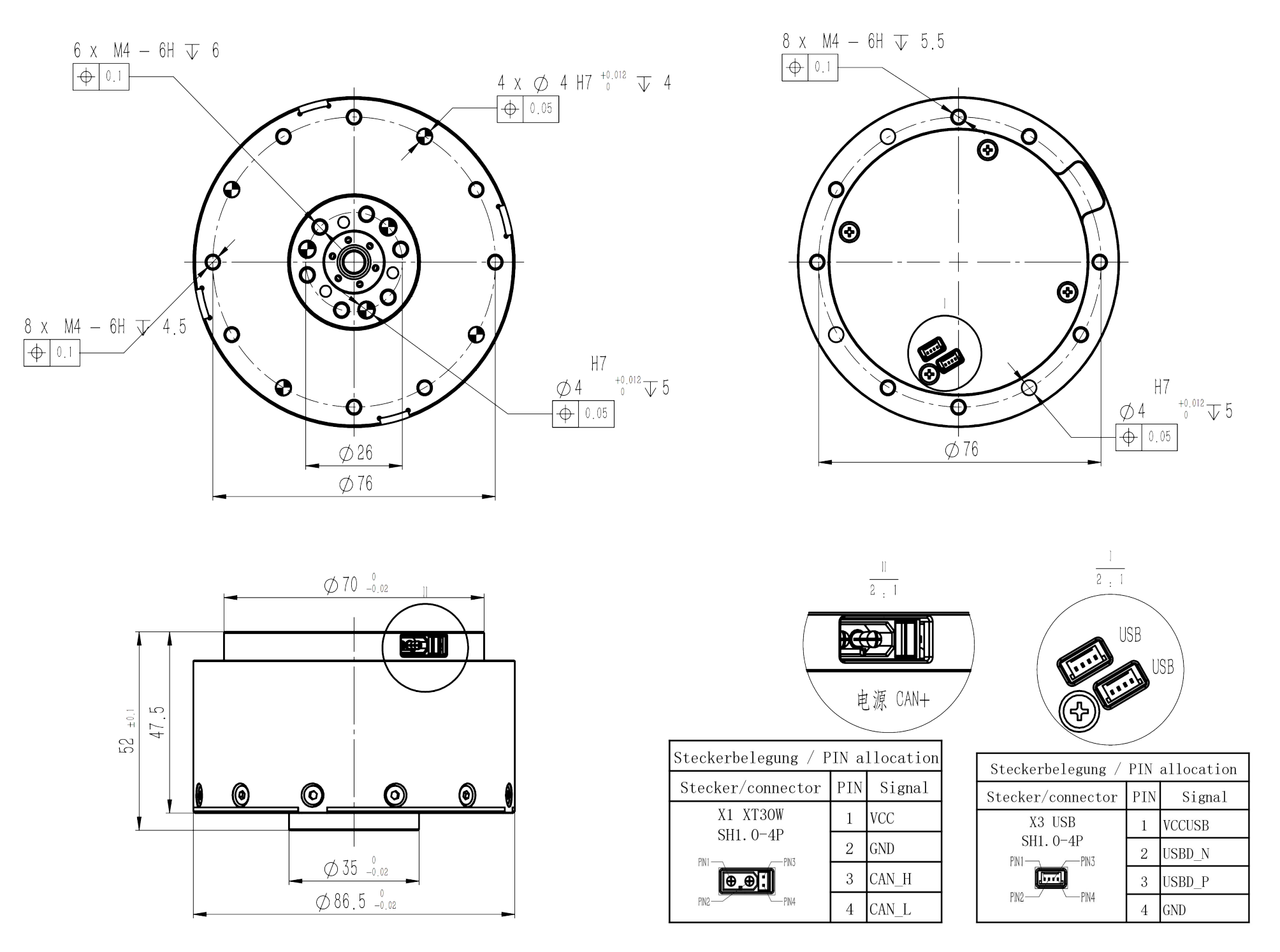
Compare the original drawing with the mating parts, loads, cable route, connectors, supply, communication protocol, and feedback requirements.
03 · Confirm the build
Confirm the selected Model 1/Model 2 configuration, current drawing revision, option content, test conditions, and validation evidence before freezing a design.
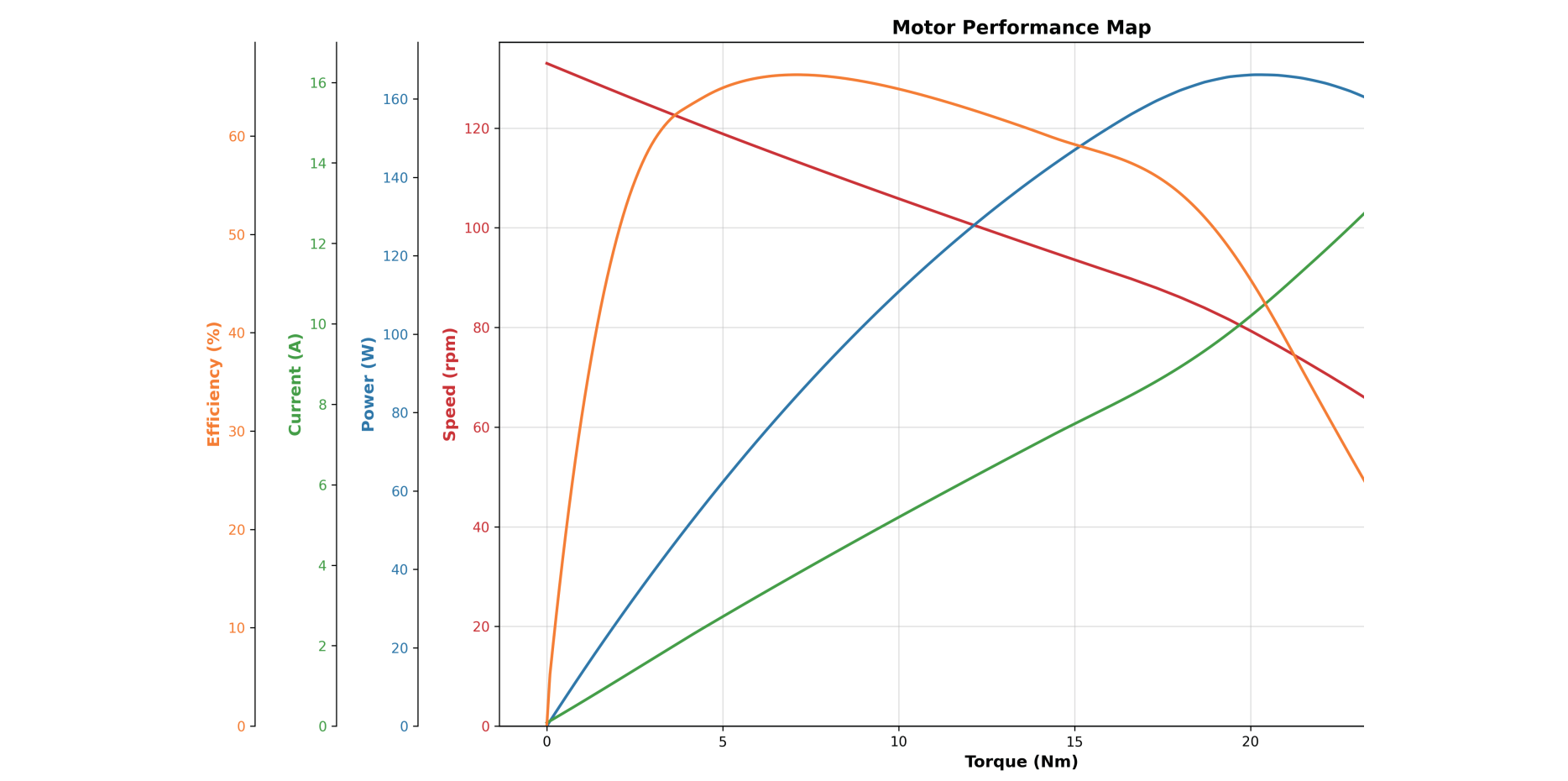
The drawing is reproduced from the supplied source image unchanged, including any visible source mark. The performance-map image is also used unchanged. Its graphic identifies torque, speed, power, current, and efficiency axes, but does not identify curve names or a Model 1/Model 2 configuration.
These links help compare published data within the same product set. Similar headline values do not make actuators interchangeable.
Planetary · Model 1
25 Nm rated torque · 76 Nm peak torque · 39:1 ratio
Compare source dataPlanetary · Model 1
16 Nm rated torque · 50 Nm peak torque · 36:1 ratio
Compare source dataPlanetary · Model 1
30 Nm rated torque · 90 Nm peak torque · 25:1 ratio
Compare source dataInclude the project inputs that let an engineer compare the source data with your mechanism. Unknown requirements can stay open; they should not be replaced with assumed operating limits.
Model 1 lists 27 Nm rated torque and 82 Nm under the source label “Peak torque (>3 s),” with 30 RPM rated speed and 64 RPM peak speed. The catalogue operating-condition note below applies unless a field is specified otherwise.
The catalogue labels its columns Model 1 and Model 2 but does not define the configuration difference. This page preserves both columns as printed. Confirm the intended build before choosing a configuration.
No. Use the table as a source-backed screening record. Confirm the required torque-speed profile, peak duration and repetition, duty cycle, thermal limits, mounting loads, controls, and operating environment before design release.
The supplied map shows axes for torque, speed, power, current, and efficiency but does not label the curves or identify a Model 1/Model 2 configuration. Confirm the applicable configuration and test conditions before using the map for controller or thermal sizing.
Share the torque-speed profile, peak duration, mounting drawing, power and control requirements, quantity range, and target validation. An initial review identifies missing inputs and next steps; it does not confirm performance, price, stock, or delivery timing.
An initial review identifies missing inputs and next steps. It does not by itself confirm feasibility, performance, price, or delivery timing.